


Counterfeit Detector Light Guide: Spotting Fake Money Made Easy
Introduction
If you’re responsible for handling cash every day, you already know one thing: fake banknotes are getting harder to spot. Modern counterfeits look, feel, and even smell real. That’s why relying on eyesight alone is risky—and costly. A Counterfeit Detector doesn’t just shine a random light on a bill; it uses carefully selected technologies to reveal what the naked eye can’t see. In this guide, you’ll learn exactly what kind of light is used in a counterfeit detector, how it works, and why choosing the right detector matters for your business.
Why Light Matters in a Counterfeit Detector
 A counterfeit detector machine works by exposing hidden security features embedded in genuine currency. These features are invisible under normal conditions but react predictably under specific types of light.
If you’re sourcing the best counterfeit money detector or upgrading your current equipment, understanding these light types helps you evaluate product quality—not just price.
How Different Light Technologies Work in a Counterfeit Detector Machine

UV Counterfeit Detector Light: Revealing Invisible Security Features
Why UV Light Is Essential
UV counterfeit detector technology uses UV-A light at approximately 365 nm, which is the global standard adopted by central banks. Genuine banknotes are manufactured with UV-reactive materials that respond in a controlled way under ultraviolet exposure.
Under a counterfeit detector light, authentic notes typically show:
-
Embedded fluorescent fibers scattered randomly
-
Security threads glowing specific colors
-
Official symbols or denomination markers appearing clearly
Counterfeit notes often fail because:
-
The entire paper glows (incorrect paper composition)
-
Colors appear too bright or inconsistent
-
Security features are missing or misplaced
This is why how to detect counterfeit money with UV light remains one of the most searched verification methods worldwide.
Practical UV Detection in Real Use
In professional environments, UV detection is fully automated. A money counterfeit detector scans the note while UV LEDs illuminate it evenly. Optical sensors compare fluorescence patterns against stored currency data—no guessing required.
This automation significantly reduces human error and speeds up cash handling.
White Light Inspection: Confirming What UV Can’t Show

What White Light Verifies
While UV light reveals hidden elements, white light is used to validate visible security details, including:
-
Watermarks
-
Microtext clarity
-
Portrait sharpness
-
Color transitions and fine line printing
High-quality best counterfeit bill detector machines integrate white LED arrays to illuminate both sides of the note evenly.
From experience: many counterfeit bills pass UV checks but fail white-light inspection due to poor printing resolution.
Infrared (IR) Light: Detecting Advanced Counterfeits
How IR Light Works
Infrared detection focuses on IR-absorbing and IR-transparent inks used in genuine banknotes. When exposed to IR light:
-
Certain printed areas disappear completely
-
Other areas remain visible
-
The resulting pattern must match official currency standards
This makes IR technology critical for detecting high-quality counterfeit currency designed to defeat UV checks.
Professional counterfeit currency detectors use infrared sensors to compare reflected and absorbed IR signals in milliseconds.
Why IR Matters for Buyers
If you’re sourcing the best counterfeit bill detector, IR detection is no longer optional—it’s essential for high-risk cash environments like retail chains, exchange offices, and banks.
Magnetic Detection: Verifying Ink Composition
Although magnetic detection does not rely on light, it complements optical systems perfectly.
Genuine banknotes contain magnetic ink particles embedded in specific printed areas. A counterfeit detector machine uses magnetic sensors to measure magnetic signal strength and distribution.
Fake notes may:
-
Contain no magnetic ink
-
Use incorrect magnetic density
-
Show inconsistent magnetic patterns
Combined with UV and IR, magnetic detection dramatically improves accuracy.
Size, Thickness, and Edge Sensors: Physical Validation
Modern best counterfeit money detectors also verify:
-
Banknote length and width
-
Thickness consistency
-
Edge alignment
These parameters help identify trimmed, washed, or altered notes—issues that light alone cannot detect.
Multi-Sensor Counterfeit Detectors: The Professional Standard
Modern financial environments demand speed and certainty.
Professional-grade detectors now combine:
-
Counterfeit detector light (UV + white)
-
Infrared sensors
-
Magnetic sensors
-
Size and thickness detection
These machines verify bills in any orientation, usually in less than 0.5 seconds.
| Feature | Benefit |
|---|---|
| UV Light | Reveals fluorescent security features |
| White Light | Confirms print quality |
| IR Detection | Verifies special inks |
| Magnetic Sensors | Confirms magnetic ink |
| Size Detection | Blocks wrong-dimension notes |
This is why money counting machines with counterfeit detector functions are replacing manual inspection across retail chains.
How Counterfeit Detectors Verify Banknotes in Any Orientation
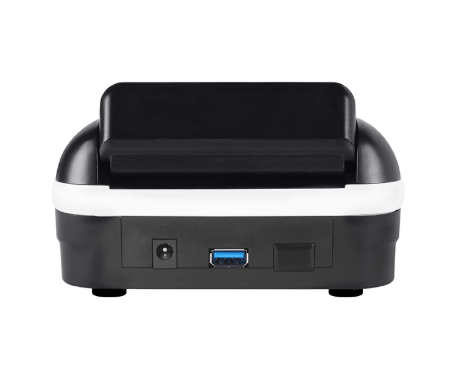
What “Any Orientation” Really Means
When manufacturers claim a detector can verify notes in any orientation, it means the machine does not require manual alignment. The bill can be inserted:
-
Face up or face down
-
Front or back
-
Rotated 180 degrees
This is a major advantage in high-traffic environments.
4-2 The Technology Behind Orientation-Free Verification
To achieve this, advanced counterfeit detector machines use:
-
Symmetrical sensor layouts
-
Dual-sided UV, IR, and magnetic scanning paths
-
High-speed processors with multi-directional currency algorithms
As the note passes through, the system automatically identifies its orientation and applies the correct verification logic in real time.
This is why professional money counting machines with counterfeit detector functions can process bills at high speed without sacrificing accuracy.
Speed and Efficiency
In premium models, verification takes less than 0.5 seconds per banknote. This dramatically reduces queues, fatigue, and operational delays—especially during peak hours.
How to Choose the Best Counterfeit Detector Machine
Choosing the best counterfeit detector machine is not about buying the most expensive model—it’s about selecting the right combination of detection accuracy, speed, compatibility, and long-term reliability. As a buyer, you’re not just purchasing a device; you’re investing in risk control.
Let’s break this down in a practical, procurement-focused way.
Prioritize Multi-Sensor Detection, Not Single-Light Devices
A common mistake buyers make is choosing a UV-only counterfeit detector. While UV is essential, it is no longer sufficient on its own.
The best counterfeit money detector should integrate:
-
UV counterfeit detector light for fluorescent features
-
Infrared (IR) detection for special ink patterns
-
Magnetic detection for genuine magnetic ink
-
Size and thickness sensors for physical verification
This multi-layer approach dramatically reduces false acceptance rates and is now standard in professional counterfeit currency detectors.
Rule of thumb: If a machine advertises only UV detection, it’s designed for low-risk environments—not serious cash handling.
Compatibility With Money Counting Machines
If you’re already using—or planning to use—a money counter with counterfeit detector, compatibility is key.
Standalone detectors are useful, but integrated systems provide:
-
Automatic counting and authentication
-
Unified reporting
-
Reduced manual handling
Modern money counting machine counterfeit detector solutions combine UV, IR, and magnetic detection into one streamlined workflow, making them ideal for medium to large-scale cash operations.
Accuracy Over Sensitivity: Avoid False Rejections
High sensitivity does not always mean high accuracy.
The best counterfeit detector balances:
-
Low false acceptance (letting fake notes pass)
-
Low false rejection (rejecting genuine notes)
Poorly calibrated machines frustrate staff and slow down operations. Look for devices with intelligent algorithms that adapt to currency variations and wear conditions.
Currency Support and Upgrade Capability
If your business handles multiple currencies, choose a counterfeit detector machine that supports:
-
Multiple international currencies
-
Firmware updates for new banknote series
-
Future-proof expansion
This is especially important for wholesalers, exchange offices, and cross-border retailers.
Build Quality and Daily Usability
A detector used all day must be built for continuous operation.
Key usability factors include:
-
Compact footprint (fits any workspace)
-
Clear LED or LCD indicators
-
Simple error alerts
-
Durable feed mechanisms
Professional buyers often underestimate ergonomics—but staff efficiency depends on it.
Conclusion
A counterfeit detector isn’t just a box with a lamp. It’s a system built around precise light technologies that expose what fraudsters want hidden. From UV counterfeit detectors to IR and magnetic sensors, layered detection is now the standard—not the upgrade.
If you’re serious about reducing risk, improving speed, and protecting your cash flow, investing in a Chuanwei Counterfeit Detector is a practical next step. Reach out to explore models that fit your operation—and stop leaving authenticity to chance.
FAQs
Q1:What kind of light is used in a counterfeit detector?
Most detectors use UV-A light (365 nm), often combined with white and infrared light.
Q2:Is UV light enough to detect fake money?
UV works for basic counterfeits, but high-quality fakes require IR and magnetic detection.
Q3:How to detect fake notes with UV light?
Check for correct fluorescence patterns—real notes glow only in specific areas.
Q4:What is the best counterfeit bill detector machine for businesses?
Multi-sensor models with UV, IR, magnetic, and size detection offer the highest accuracy.
Q5:Why choose Chuanwei counterfeit detectors?
They combine speed, accuracy, and industrial-grade reliability backed by 20+ years of experience.

