


How OEM Cash Counting Machines Help Brands Expand Product Lines
For cash-handling brands, office-equipment distributors, and fintech startups, expanding into banknote counting hardware used to mean one of two things: investing millions in your own production line, or reselling someone else’s machines with someone else’s logo. Today there is a third, far smarter path — partnering with an OEM cash counting machine manufacturer. In more than twenty years of building currency equipment at our factory, we have watched this model turn small regional distributors into recognized national brands. This guide explains exactly how OEM works, what you can customize, and how to use it to build a product line that carries your name from top to bottom.
What Is an OEM Cash Counting Machine?
OEM stands for Original Equipment Manufacturer. In the cash-handling industry it means the manufacturer designs and produces the machines, while your brand sells them under your own name — with your logo on the housing, your branding on the packaging, and your company on the warranty card. Your customer sees only your brand; the factory stays invisible in the background.
It is worth distinguishing OEM from ODM before you sign anything: OEM typically means producing to your specification or branding an existing platform, while ODM means the factory also owns more of the design decisions. If you are unsure which model fits your business, we explain the difference in detail in our guide to the OEM vs ODM partnership model for bill counter distributors. For most brands expanding an existing line, OEM is the faster and more controlled route.

6 Ways OEM Cash Counting Machines Accelerate Product Line Expansion
1. Dramatically Faster Time to Market
Developing a banknote counter from scratch — sensor calibration, firmware, counterfeit detection tuning, tooling — typically takes 12 to 18 months and a dedicated R&D team. With an OEM partner whose platforms are already field-proven, you move from enquiry to branded samples in weeks, not years. In our own OEM projects, a standard model with logo and packaging customization usually reaches sample stage in 15 to 30 days, which means you can hit a planned season or tender deadline instead of watching it pass.
2. Lower Upfront Investment, Predictable Costs
A production line for currency equipment means molds, SMT lines, test benches, certified engineers, and inventory. Under OEM, none of that sits on your balance sheet. You pay for finished, tested units at wholesale pricing, which turns a capital expenditure into a manageable cost of goods and frees capital for what actually grows a brand: marketing, channel development, and after-sales service.
3. Proven, Certified Hardware Reduces Risk
The fastest way to damage a new brand is to launch hardware that fails in the field. A serious OEM manufacturer has already survived years of returns analysis, currency updates, and certification audits on its platforms. Machines such as the AL-920 mixed denomination value counter with ECB test carry bank-grade authentication (UV, MG, IR, CIS) that would take a newcomer years to validate. Your brand inherits that reliability on day one.
4. Full Brand Control, Front to Back
Modern OEM goes far beyond a sticker. Depending on order volume, you can customize:
- Hardware: housing color, boot-up logo, control panel layout, display language
- Software: counting modes, currency presets for your market, feature toggles
- Identity: nameplate, printed housing, retail packaging, user manuals, warranty documents
The result is a machine your customers will assume you built yourself — which is exactly the point.
5. Scale Flexibly From First Order to Full Range
OEM lets you test a market with a modest first batch, then scale the winning models. Many of our brand partners start with one entry-level counter, confirm demand in six months, and then expand into a three-tier range — entry, mid-range, and value-counting models — all under the same brand. You can browse the breadth of platforms available for private labeling in our full bill counter product line.
6. Focus on What Brands Do Best
Every hour your team spends on production troubleshooting is an hour not spent on distribution, key accounts, or service. OEM shifts manufacturing risk to the partner whose core competence is manufacturing, and keeps your team’s focus on the competences that build brand equity.
Ready to Put Your Brand on a Cash Counting Machine?
Send us your target market and volume, and our OEM team will recommend the right platform, prepare branded samples, and quote within one business day.
What Can Realistically Be Customized? A Practical View
Brands often arrive expecting either “just a logo” or unlimited reinvention. The truth is in between, and it maps cleanly to order volume:
| Customization Item | Typical Options | Usual MOQ Impact |
|---|---|---|
| Nameplate / logo | Metal plate, silk-screen print, molded-in badge | Very low |
| Housing color | Standard or custom Pantone color | Medium |
| Firmware & currencies | Market-specific currency presets, counting modes, boot logo | Low–medium |
| Packaging & documents | Branded cartons, manuals, quick-start guides, warranty cards | Very low |
| Full custom housing | New mold and industrial design | High volume only |
Our advice after hundreds of OEM projects: start with nameplate, packaging, and firmware presets. They deliver 90% of the branding impact at a fraction of the cost of custom tooling, and they keep your first order nimble.
Matching Machines to Each Tier of Your Product Line
A coherent range beats a random assortment of models. The structure that works for most brands has three tiers:
- Entry tier — basic counting for retail and small offices. Compact, easy to train staff on, and priced for volume. The AL-1600 compact bill counter with LCD display is a typical platform here: small footprint, straightforward controls, dependable daily counting.
- Mid tier — value counting and counterfeit detection. This is where banks, casinos, and cash-intensive retail concentrate. Mixed-denomination value counters with CIS sensors and multi-currency recognition live at this level.
- Professional tier — sorters and bank-grade authentication. Higher-speed serial-number reading and sorting for central banks and large cash centers.
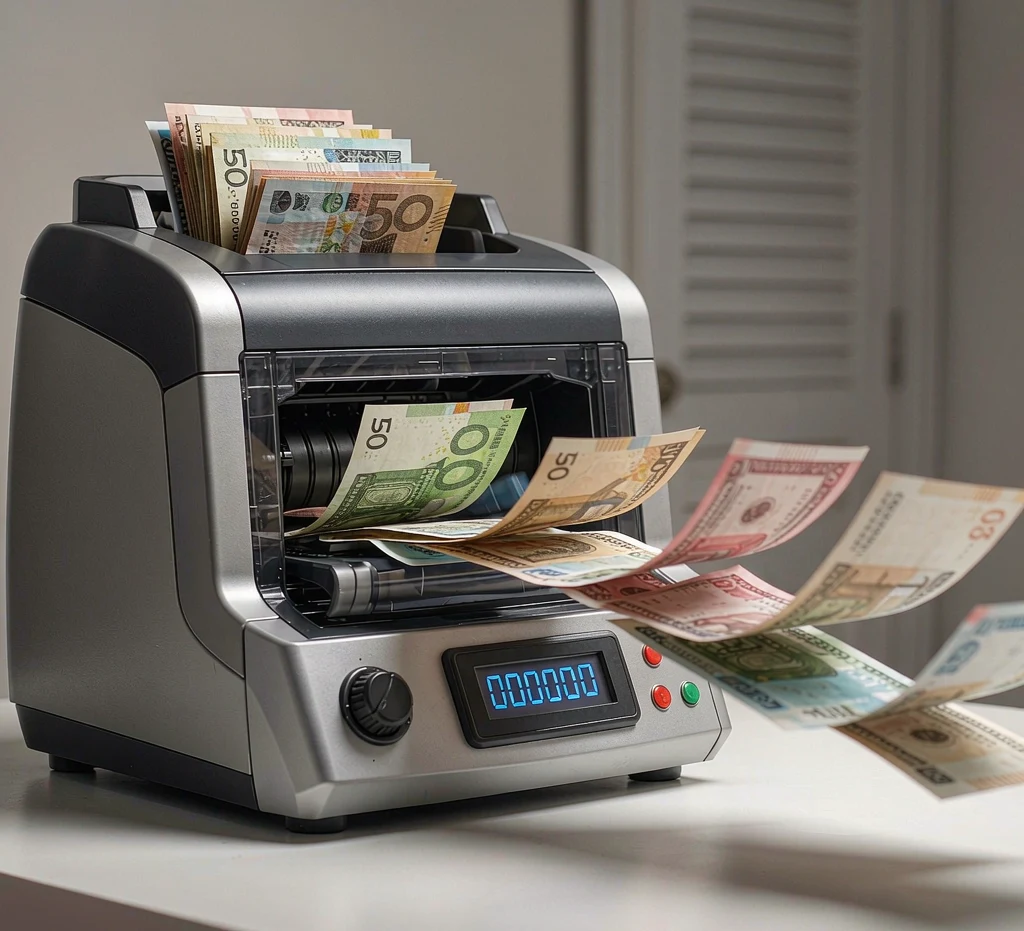
Because all three tiers can share one OEM partner, your brand delivers a consistent look, consistent menus, and one service standard across the whole range — something reselling mixed factory brands can never achieve.
Not Sure Which Platforms Fit Your Market?
Tell us your customers and price points, and we will map a three-tier OEM product line for you — free, with sample availability included.
How the OEM Process Works: From Enquiry to Your Branded Line
A well-run OEM project follows five predictable steps:
- Requirement consultation. You define target market, currencies, volume, and price positioning; the manufacturer recommends platforms.
- Sample and specification confirmation. You receive branded samples, test them with real banknotes from your market, and lock the specification.
- Customization and certification. Nameplate, packaging, and firmware are produced; regional certifications are confirmed.
- Pilot order. A smaller first batch validates logistics, packaging, and early customer feedback.
- Mass production and after-sales. Ongoing supply with spare parts, technical training, and warranty support.
Before committing, interrogate your candidate factories properly. We compiled the most useful checks in our list of questions to ask before choosing a bill counter OEM manufacturer — covering certifications, spare-part commitments, and firmware update policies. A manufacturer that answers them clearly is a partner; one that dodges them is a supplier you will outgrow.
Frequently Asked Questions
What does OEM mean for cash counting machines?
OEM means the manufacturer produces the machines and your brand sells them under its own name, with your logo, packaging, and documentation. The factory remains invisible to your customers.
What is the typical MOQ for OEM bill counters?
For nameplate and packaging customization, MOQs are usually modest — often a few dozen to a few hundred units depending on the model. Full custom housing requires much higher volumes because of tooling costs.
How long does OEM customization take?
Logo, packaging, and firmware preset changes on a standard platform typically take 15 to 30 days to sample stage, with mass production following after sample approval. A full custom housing adds mold-making time, usually several months.

